
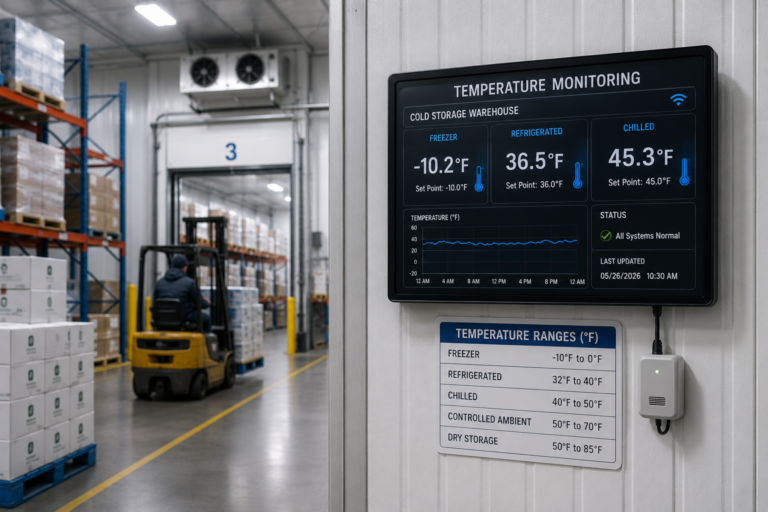
Temperature Monitoring in Cold Storage: Questions Buyers Should Ask
Temperature monitoring in cold storage is one of the most important details companies should review before choosing a warehouse. A facility may advertise frozen, refrigerated, chilled, or temperature-controlled storage, but buyers need to understand how those temperatures are tracked, recorded, and managed.
For food brands, importers, distributors, manufacturers, and shippers, a cold warehouse is only useful if it can maintain the right conditions throughout receiving, storage, picking, staging, and loading.
This guide focuses on the operational side of temperature control: monitoring systems, temperature logs, alerts, dock procedures, backup power, and the questions buyers should ask before sending inventory.
Why Temperature Monitoring Matters
Cold storage depends on consistency. A product may be stored in the right zone, but risk can still occur if temperatures fluctuate, products sit too long on the dock, doors are left open, equipment fails, or outbound loads are staged incorrectly.
For general food safety context, FDA recommends refrigerators at 40°F or below and freezers at 0°F. USDA identifies the food safety “danger zone” as 40°F to 140°F. Exact commercial requirements vary by product, but the broader point is clear: temperature-sensitive products need controlled handling, not just cold rooms.
Temperature monitoring helps buyers understand whether a provider has visibility and a process for managing those conditions.
What Temperature Monitoring Actually Means
Temperature monitoring is the process a warehouse uses to measure, record, and respond to temperatures in storage areas and sometimes in receiving, staging, and loading areas.
Depending on the facility, this may include:
- Digital sensors
- Manual checks
- Data loggers
- Temperature probes
- Remote alarms
- Automated alerts
- Temperature reports
- Warehouse management system records
- Corrective action procedures
The key question is not simply, “Do you monitor temperature?” Most providers will say yes. The better question is, “How do you monitor temperature, and what happens when something goes wrong?”
Continuous vs. Manual Monitoring
Some cold storage warehouses use continuous monitoring systems. Others use scheduled manual checks. Some use both.
Continuous monitoring may provide more frequent readings and faster alerts. Manual checks may still be part of a good process, especially when documented and reviewed consistently.
Ask:
- Is temperature monitoring continuous, manual, or both?
- How often are readings taken?
- Are readings recorded automatically?
- Who reviews the records?
- Are alerts triggered when temperatures move outside range?
- Are readings separated by storage zone?
- Can customers request records?
You do not need the provider to overcomplicate the answer. You need a clear explanation of how they verify that each zone stays within range.
Ask About Temperature Logs
Temperature logs can be important if there is ever a product quality concern, customer dispute, rejected shipment, or insurance claim.
Ask:
- Do you maintain temperature logs?
- How long are logs retained?
- Can customers request temperature records?
- Are logs available by zone?
- Are logs tied to product locations or general warehouse areas?
- Are logs reviewed routinely?
- What happens if a log shows an exception?
Not every buyer will need regular access to temperature logs, but the provider should know whether they are available and how they are used.
Alerts and Corrective Action
Monitoring only helps if the warehouse responds when there is an issue.
Ask:
- What temperature limits trigger an alert?
- Who receives the alert?
- Are alerts monitored after hours?
- What corrective action is taken?
- Are customers notified?
- Is the event documented?
- How do you confirm the issue has been resolved?
A strong provider should have a defined escalation process. If the answer is vague, that may be a warning sign.
Receiving Dock Procedures
Temperature risk often begins before product reaches the storage zone. Receiving is one of the most important parts of cold storage operations.
Ask:
- Is receiving appointment-based?
- Is the dock temperature controlled?
- How quickly is product moved into cold storage?
- Are trailer temperatures checked?
- Are inbound product temperatures checked?
- What happens if freight arrives too warm?
- Are damaged or questionable loads photographed?
- How are discrepancies reported?
A warehouse may have excellent freezer or cooler space but still create risk if freight sits too long during receiving.
Staging, Picking, and Loading
Temperature-sensitive products may leave the storage zone during picking, staging, and loading. Buyers should understand how the provider manages that exposure.
Ask:
- Where are orders staged before shipping?
- Is the staging area temperature controlled?
- How long can product remain outside the storage zone?
- Are outbound loads checked before departure?
- Are reefer trailers pre-cooled before loading?
- Can the warehouse coordinate cold transport?
- How are rush orders handled?
The FDA’s sanitary transportation rule is designed to reduce food safety risks during transportation, including failure to properly refrigerate food and failure to protect food during transport. That makes coordination between cold storage and cold transport especially important for certain food shipments.
Backup Power and Equipment Failure
Cold storage buyers should ask what happens when things do not go according to plan.
Ask:
- Is backup power available?
- What systems are connected to backup power?
- How are refrigeration failures detected?
- Who responds to equipment issues?
- Are emergency procedures documented?
- Has the facility handled outages before?
- How are customers notified during an emergency?
No provider can eliminate every risk. But a professional provider should be able to explain its emergency plan.
Multiple Temperature Zones
If a warehouse offers frozen, refrigerated, chilled, and controlled ambient space, each zone should be monitored appropriately.
Ask:
- Are temperature zones monitored separately?
- How do you prevent products from being stored in the wrong zone?
- Are product locations tied to temperature zones?
- Can reports be separated by zone?
- How are mixed-temperature accounts handled?
- Are doors, transitions, and staging areas managed carefully?
This is especially important for companies storing several product types in one facility.
What Buyers Should Request Before Sending Inventory
Before sending temperature-sensitive products to a cold storage provider, request:
- The exact temperature range for the required zone
- Basic explanation of monitoring process
- Temperature log availability
- Receiving procedure
- Staging and loading procedure
- Backup power or emergency plan
- Claims or incident reporting process
- Main contact for urgent issues
- Written pricing and handling terms
This does not need to become a complicated audit. It is simply a practical way to compare providers before making a commitment.
Warning Signs to Watch For
Be cautious if a provider:
- Cannot define its temperature ranges
- Gives vague answers about monitoring
- Does not know whether logs are available
- Cannot explain alert procedures
- Does not control or manage staging time
- Has unclear receiving procedures
- Does not document temperature issues
- Avoids questions about backup power
- Cannot explain how customers are notified during problems
A provider does not need to be perfect, but it should be transparent.
FAQ
What is temperature monitoring in cold storage?
Temperature monitoring in cold storage is the process of measuring, recording, and managing temperatures in frozen, refrigerated, chilled, or temperature-controlled warehouse areas.
Why are cold storage temperature logs important?
Temperature logs can help show whether a storage area stayed within the expected range. They may also help investigate product quality concerns, rejected shipments, or delivery disputes.
Should cold storage warehouses use continuous monitoring?
Continuous monitoring can provide frequent readings and faster alerts, but some facilities may use manual checks or a combination. Buyers should ask how monitoring is performed and documented.
What should I ask a cold storage warehouse about temperature monitoring?
Ask about monitoring frequency, logs, alerts, storage zones, receiving dock procedures, staging areas, backup power, and customer notification if an issue occurs.
Does temperature monitoring matter during transportation too?
Yes. Temperature control also matters during refrigerated transportation. FDA’s sanitary transportation rule specifically addresses transportation practices that can create food safety risks, including failure to properly refrigerate food.
Find Cold Storage Providers on National Freight Hub
Temperature monitoring in cold storage is one of the key details buyers should compare before choosing a warehouse.
Use National Freight Hub to browse cold storage warehouses, refrigerated warehousing providers, cold transport companies, temperature-controlled facilities, and food-grade logistics partners that fit your product, location, and handling needs.
