
FBA Prep for Imported Products: What Amazon Sellers Should Know
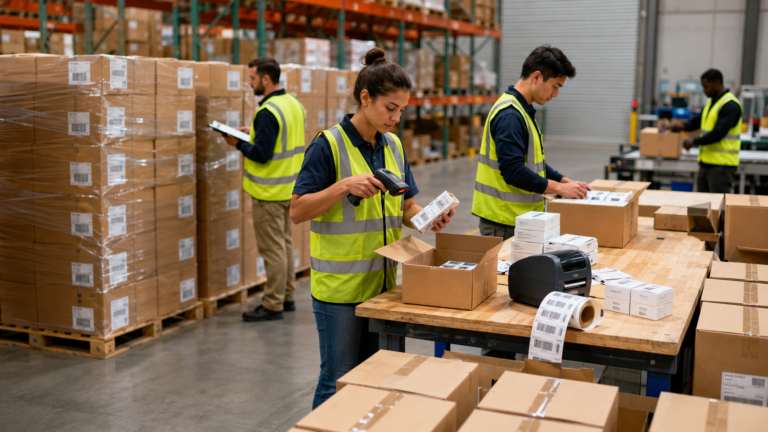
FBA prep for imported products gives Amazon sellers a U.S.-based checkpoint between international freight and Amazon fulfillment. Once goods arrive in the United States, sellers may need a facility to receive freight, check carton condition, inspect products, apply FNSKU labels, prepare units, store inventory, and forward cartons to Amazon fulfillment centers.
For imported inventory, that checkpoint can matter. A shipment may arrive from an overseas supplier, freight forwarder, customs broker, port warehouse, or domestic trucking partner. Before it goes to Amazon, someone needs to confirm that the products are properly labeled, packaged, counted, and ready for FBA receiving.
This is especially important now because Amazon states that starting January 1, 2026, it no longer offers prep and item labeling services for FBA shipments in the U.S. store. Sellers that previously relied on Amazon for some prep or labeling may now need to handle those steps before inventory arrives at Amazon.
Why Imported Products Often Need FBA Prep
Imported products may arrive from a factory, freight forwarder, container freight station, port warehouse, or domestic trucking partner. They may be palletized, floor-loaded, mixed by SKU, missing retail-ready packaging, or labeled for general retail rather than Amazon FBA.
An FBA prep center can help with:
- Receiving imported cartons or pallets
- Counting cartons and units
- Checking for visible freight damage
- Separating SKUs
- Applying FNSKU labels
- Covering manufacturer barcodes when required
- Poly bagging or bubble wrapping products
- Bundling or kitting multipacks
- Inspecting product and packaging condition
- Storing inventory temporarily
- Forwarding cartons to Amazon
The goal is not just to “touch the product.” The goal is to reduce problems before inventory reaches Amazon’s fulfillment network.
Where FBA Prep Fits in the Import Process
A common imported-product flow looks like this:
- Product leaves overseas supplier.
- Freight forwarder coordinates ocean or air freight.
- Customs broker clears the shipment.
- Goods arrive at a U.S. port, warehouse, or freight terminal.
- FBA prep center receives and prepares inventory.
- Seller creates or updates Amazon shipment plans.
- Prep center forwards cartons to Amazon.
For sellers importing through major markets such as Los Angeles/Long Beach, New York/New Jersey, Savannah, Houston, Miami, or Seattle/Tacoma, location can matter. An FBA prep center near a port or major warehouse market may reduce extra handling and shorten the path between import arrival and Amazon shipment.
What Imported Product Sellers Should Ask
Before choosing an FBA prep provider, ask operational questions that match imported freight:
- Can you receive palletized freight?
- Can you receive LTL or full truckload deliveries?
- Do you work with freight forwarders?
- Can you receive shipments from a container freight station?
- How quickly do you check in inbound inventory?
- Do you count cartons, units, or both?
- Can you separate mixed SKUs?
- Do you photograph visible damage?
- Can you inspect product packaging against reference photos?
Imported inventory often involves higher risk because the seller may not see the product before it arrives. The prep center may be the first U.S.-based checkpoint.
Labeling and Barcode Requirements
Amazon requires FBA inventory to have proper barcodes. Amazon’s product packaging requirements say each unit must have an exterior scannable barcode or label, and any FNSKU used on a unit must be unique and correspond to one unique product.
That matters for imported goods because overseas suppliers may apply manufacturer barcodes, internal factory labels, or carton labels that are not sufficient for FBA receiving. A prep center should understand whether a product needs an Amazon barcode, whether existing barcodes must be covered, and where labels should be placed.
Sellers should confirm this before production or shipment. It is often easier to have packaging designed correctly at the factory than to fix every unit later in the U.S.
Inspection Matters for Imported Products
Inspection is one of the biggest reasons sellers use FBA prep for imported products. A prep center may help identify visible issues such as:
- Crushed cartons
- Water damage
- Incorrect packaging
- Missing inserts
- Wrong color or variation
- Labeling errors
- Mixed SKUs
- Damaged retail boxes
- Poor bundle presentation
Not every prep center offers the same level of inspection. Some only check carton condition. Others can inspect a sample or every unit.
Ask:
- Do you inspect every unit or a sample?
- Can you compare product to reference photos?
- Do you check packaging condition?
- Can you separate damaged units?
- Do you provide photos or inspection notes?
- Can you report discrepancies before prep begins?
For private-label products, inspection can help catch problems before Amazon receives the inventory and before customers begin ordering.
Storage and Shipment Timing
Imported goods do not always move directly to Amazon. Sellers may need temporary storage because of Amazon capacity limits, shipment planning, seasonal timing, or inventory placement decisions.
Ask the prep center:
- Do you offer short-term storage?
- How is storage charged?
- Can you store by pallet, carton, or unit?
- Can you split inventory across multiple Amazon shipments?
- Can you hold inventory while shipment plans are created?
- Can you forward cartons to different Amazon destinations?
Amazon explains that FBA costs include fulfillment and storage, and FBA storage costs are based on the daily average volume your inventory occupies in Amazon fulfillment centers. For sellers trying to manage inventory flow, third-party storage before FBA may be part of the strategy.
Common Mistakes Importers Make
One common mistake is assuming the overseas supplier understands Amazon FBA requirements. Some factories can apply labels and prep products correctly, but others cannot.
Another mistake is sending goods directly from port to Amazon without a quality checkpoint. That may work for highly reliable supply chains, but it gives the seller less control if something is wrong.
A third mistake is not confirming barcode requirements before production. Fixing labels after import can be expensive and time-consuming.
FAQ
What is FBA prep for imported products?
FBA prep for imported products is the process of receiving, inspecting, labeling, packaging, storing, and forwarding imported goods before they are sent to Amazon fulfillment centers.
Do imported products need FNSKU labels?
Some do. Amazon barcode requirements changed as of March 31, 2026, and brand owners may continue to use manufacturer barcodes without stickers in certain cases, while resellers are required to use Amazon barcodes even if products have manufacturer barcodes. Sellers should verify the correct barcode setting in Seller Central before shipping.
Should I send imported goods directly to Amazon?
It depends. Direct shipping may work when products are already properly packaged, labeled, and compliant. Many sellers use a prep center when they need inspection, relabeling, storage, bundling, or shipment splitting.
Why use an FBA prep center near a port?
A prep center near a port or major logistics hub may reduce extra transportation, especially for sellers importing through Los Angeles/Long Beach, New York/New Jersey, Savannah, Houston, Miami, or Seattle/Tacoma.
Find FBA Prep Providers on National Freight Hub
FBA prep for imported products helps sellers create a cleaner handoff between international freight and Amazon fulfillment.
Use National Freight Hub to compare FBA prep centers, import logistics providers, freight forwarders, customs brokers, and warehousing partners that support Amazon sellers and e-commerce brands.
