
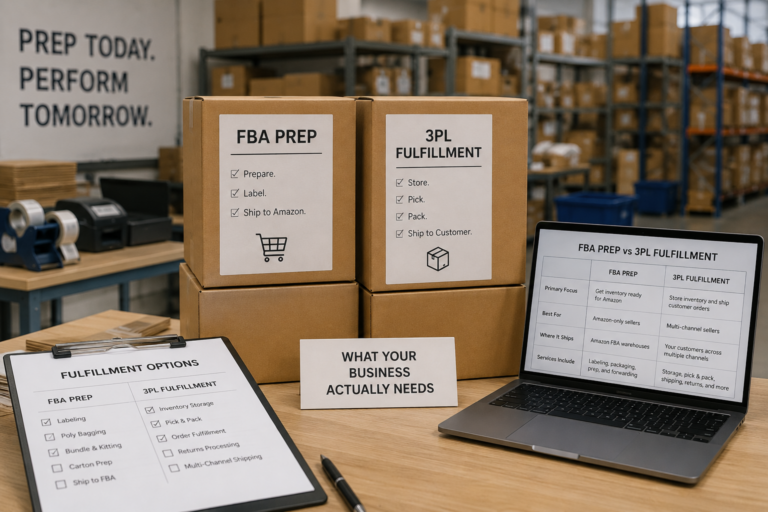
Comparing FBA prep vs 3PL fulfillment is less about the provider name and more about whether you need Amazon-ready prep, customer order fulfillment, or both. FBA prep vs 3PL fulfillment is an important distinction for Amazon sellers because the two services solve different problems. FBA prep gets inventory ready for Amazon. A 3PL fulfillment provider stores inventory and ships customer orders across one or more sales channels.
That difference matters as a seller grows. A prep center may be the right fit when inventory only needs labeling, packaging, carton forwarding, or shipment prep before going to FBA. A 3PL may be the better fit when the business needs storage, direct-to-customer shipping, wholesale fulfillment, returns processing, or inventory outside Amazon.
The right choice depends less on the provider’s label and more on the work you actually need done.
For an Amazon seller, the distinction matters. A basic prep center may be excellent at FNSKU labels and Amazon shipment requirements but completely wrong for daily Shopify fulfillment. A 3PL may be strong at pick-and-pack fulfillment but weak on Amazon-specific prep details. The right choice depends on how your inventory moves, where you sell, and how much control you need before products reach customers.
Amazon describes FBA as a program where sellers send products into Amazon’s fulfillment network, and Amazon stores, picks, packs, ships orders, and handles customer service and returns. FBA prep happens before that handoff.
FBA Prep vs 3PL Fulfillment: The Practical Difference
The cleanest way to think about it is this:
| Service | Main Job | Best Fit |
| FBA Prep | Gets inventory ready for Amazon FBA | Sellers sending inventory into Amazon |
| 3PL Fulfillment | Stores inventory and ships orders | Sellers fulfilling orders across Amazon, Shopify, Walmart, wholesale, or other channels |
That sounds simple, but the operational differences are important.
FBA prep is usually shipment-focused. Inventory arrives, gets prepared, and moves out to Amazon. A 3PL relationship is usually more ongoing. Inventory sits in the warehouse, orders come in every day, and the provider picks, packs, ships, reports inventory, and manages exceptions.
If you only sell through Amazon FBA, a focused prep center may be enough. If you sell through Amazon plus your own website, wholesale customers, retail accounts, or other marketplaces, a 3PL may be the stronger long-term fit.
When FBA Prep Is the Better Fit
FBA prep is about preventing receiving problems before they happen.
For example, an imported shipment arrives in Southern California after clearing customs. The cartons look fine from the outside, but the product still needs Amazon barcodes, several SKUs are packed in similar cartons, and a few retail boxes were crushed in transit. Sending that inventory straight to Amazon may create delays or bad customer experiences. A prep center gives the seller a U.S.-based checkpoint before the shipment disappears into the FBA network.
That checkpoint has become more important. Amazon states that starting January 1, 2026, it no longer offers prep and item labeling services for FBA shipments in the U.S. store. Sellers who previously depended on Amazon to handle prep or labels now need to make sure those steps are completed before inventory arrives at Amazon.
A strong FBA prep provider should understand Amazon’s barcode rules, packaging requirements, unit-level labels, box labels, and shipment workflow. This is not just clerical work. If the wrong FNSKU is applied to a variation, Amazon may receive the inventory, but the problem may not show up until customers start getting the wrong item.
When 3PL Fulfillment Is the Better Fit
A 3PL becomes more useful when the seller’s business is bigger than “send everything to Amazon.”
For example, a brand may want Amazon FBA for Prime demand, but also keep inventory available for Shopify orders, wholesale cartons, influencer samples, replacement shipments, or retail replenishment. In that case, sending every unit into Amazon may limit flexibility. A 3PL gives the seller another inventory position outside Amazon’s network.
This is especially useful for products that are oversized, seasonal, slow-moving, high-value, bundled differently by channel, or sold with branded packaging. A 3PL can also support returns in a way that gives the seller more control over whether units are restocked, inspected, discarded, or held for review.
The tradeoff is that a 3PL may not automatically be an Amazon prep expert. Some 3PLs are excellent at direct-to-consumer fulfillment but do not want to deal with FBA shipment plans, box label matching, or FNSKU verification. Others offer both services and do them well. The seller needs to confirm the details rather than assume.
Why Barcode Rules Matter for FBA Prep and 3PL Fulfillment
Amazon barcode rules changed in 2026. Amazon says that as of March 31, 2026, brand owners can continue using manufacturer barcodes without stickers in certain cases, while resellers are required to use Amazon barcodes even if the product already has a manufacturer barcode.
That means barcode handling is no longer a background detail. It is one of the first things a seller should clarify with any provider touching Amazon-bound inventory.
A prep center should know how to handle FNSKU labels, manufacturer barcodes, conflicting visible barcodes, bundles, multipacks, and unit-level label placement. A 3PL that offers FBA prep should be able to explain the same process clearly. If the provider only says, “Yes, we ship to Amazon,” that is not enough.
Amazon also requires each box in an FBA shipment to have its own FBA box ID label printed from the shipment workflow, and both labels must remain uncovered, scannable, and readable. That is where sloppy carton forwarding creates problems. A unit may be labeled correctly, but if the wrong box label goes on the wrong carton, the shipment can still become messy.
Multichannel Fulfillment Changes the Decision
An Amazon-only seller may only need FBA prep if most inventory is going straight into Amazon’s fulfillment network. Once the business adds Shopify, Walmart, TikTok Shop, wholesale, retail replenishment, or subscription orders, the fulfillment model changes.
At that point, the seller may need inventory stored outside Amazon, orders shipped directly to customers, returns processed outside FBA, and stock allocated across multiple channels. That is where a 3PL can become more useful than a basic FBA prep center.
How to Choose Between FBA Prep and 3PL Fulfillment
For a seller who imports products, sells primarily through Amazon, and needs a place to receive, inspect, label, and forward inventory, FBA prep is usually the first service to look for.
For a seller building a broader e-commerce operation, a 3PL may be the better foundation. That is especially true if orders need to ship directly to customers, if returns need to be inspected, or if inventory needs to support multiple sales channels.
Many sellers eventually use both. A prep center may handle the Amazon-bound inventory, while a 3PL holds reserve inventory and fulfills non-Amazon orders. In some cases, one provider can handle both functions from the same facility. That can simplify communication, but only if the provider is genuinely strong in both areas.
The best choice is not based on the label a provider uses. It is based on the work they actually perform.
Questions to Ask Before Choosing FBA Prep or 3PL Fulfillment
A seller does not need a long interrogation to figure this out. The most useful questions are direct:
Can the provider apply and verify FNSKU labels? Can they cover conflicting barcodes when required? Can they create or follow Amazon shipment plans? Can they apply the correct FBA box labels to the correct cartons? Can they receive pallets or LTL freight from import partners? Can they also ship individual customer orders, process returns, and support non-Amazon channels?
Those answers will tell you whether the provider is mainly an FBA prep center, mainly a 3PL, or a true hybrid.
Common Mistake: Buying the Service You Used to Need
A lot of sellers choose based on their current pain point. If Amazon labels are the problem this month, they hire a prep center. If Shopify orders are becoming a headache, they look for a 3PL.
That is understandable, but it can create a short-term fix that does not match the business six months later.
A better approach is to map the inventory flow first. Where does the product arrive? What happens before Amazon? What stays outside Amazon? Which channels need fulfillment? How are returns handled? What needs inspection before it is shipped again?
Once that flow is clear, the provider choice becomes much easier.
FAQ
Is FBA prep the same as 3PL fulfillment?
No. FBA prep prepares inventory before it goes to Amazon. 3PL fulfillment usually stores inventory and ships customer orders across one or more sales channels.
Can a 3PL handle FBA prep?
Some can, but not all. Sellers should confirm whether the provider understands FNSKU labels, Amazon barcode requirements, FBA box labels, shipment plans, and carton forwarding.
When should an Amazon seller use FBA prep?
FBA prep is useful when inventory needs labeling, inspection, poly bagging, bundling, carton forwarding, or other preparation before it reaches Amazon.
When should an Amazon seller use a 3PL?
A 3PL is useful when the seller needs storage and order fulfillment outside Amazon, especially for Shopify, Walmart, wholesale, retail replenishment, returns, or multichannel inventory.
Can one company provide both?
Yes. Some providers offer both FBA prep and 3PL fulfillment. The seller should verify whether both services are handled in-house and whether the provider has real Amazon prep experience.
