
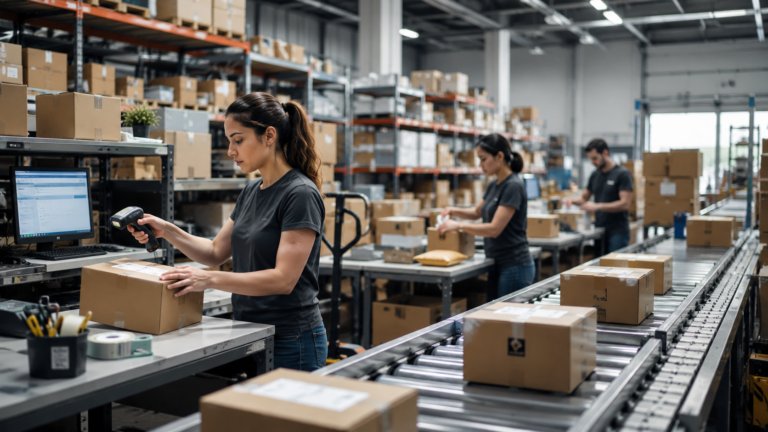
Choosing an e-commerce fulfillment provider is not just a warehouse decision. It affects delivery speed, inventory accuracy, customer experience, returns, cash flow, and how much time your team spends fixing preventable problems.
That matters because e-commerce is no longer a side channel. U.S. retail e-commerce sales reached an estimated $302.3 billion in Q1 2026, up 9.7% from Q1 2025, and accounted for 16.9% of total retail sales. Buyers expect online orders to move quickly, and brands have less room for sloppy fulfillment than they did a few years ago.
The right provider should feel like an extension of your operation, not just a building with shelves. The wrong one can create the kind of problems customers remember: late shipments, wrong items, poor packaging, missing tracking updates, or returns that disappear into a black hole.
Start With How Your E-Commerce Orders Actually Move
Before comparing fulfillment providers, map the real order flow. A brand shipping 40 lightweight orders a day from Shopify has different needs than a seller moving oversized products, subscription boxes, wholesale cartons, or marketplace orders from Amazon, Walmart, and TikTok Shop.
A good fulfillment match depends on the details: average order size, SKU count, product dimensions, return rate, sales channels, packaging needs, inventory turns, and where customers are located. If most orders ship to the Northeast, a West Coast-only warehouse may add time and cost. If the products are fragile, heavy, or high-value, packaging discipline matters more than a cheap pick fee.
The provider should be able to explain how your actual order profile would move through their facility. If the conversation stays vague, that is usually a warning sign.
What an E-Commerce Fulfillment Provider Should Handle Well
E-commerce fulfillment has a simple surface-level definition: receive inventory, store it, pick orders, pack them, ship them, and process returns. But the difference between an average provider and a strong one is in the handoffs.
Receiving needs to be accurate because every later inventory report depends on it. Storage needs to be organized because misplaced stock creates oversells and delays. Picking needs to be controlled because one wrong variation can trigger a return and a bad review. Packing needs to protect the product without wasting money on oversized cartons. Shipping needs to balance cost, speed, and customer expectations.
Returns also deserve more attention than many brands give them. NRF and Happy Returns projected that total retail returns would reach $849.9 billion in 2025, with 19.3% of online sales expected to be returned. That makes returns processing a real fulfillment function, not an afterthought.
Technology Matters, But Process Matters More
Most fulfillment providers will tell you they integrate with Shopify, Amazon, Walmart, WooCommerce, or other sales channels. That is important, but integration alone is not the same as operational quality.
A useful fulfillment system should give you clear visibility into orders, inventory, tracking, exceptions, and returns. Shopify’s own fulfillment guidance now describes its Shopify Fulfillment Network as a way for store owners to connect with 3PL partners, monitor analytics, and troubleshoot orders from Shopify admin. That reflects where the market is going: brands want fulfillment visibility without constantly leaving their commerce platform.
Still, software cannot fix weak warehouse discipline. If the provider does not receive accurately, label locations properly, train pickers, manage exceptions, and communicate quickly, a clean dashboard will only show you problems faster.
How to Compare E-Commerce Fulfillment Providers
| What to Compare | Why It Matters |
| Order accuracy | Wrong items create returns, refunds, and customer frustration |
| Receiving speed | Slow check-in delays sales and inventory availability |
| Carrier options | More options can improve cost and delivery coverage |
| Returns process | Returns affect inventory, resale value, and customer experience |
| Integrations | Orders need to flow cleanly from your selling channels |
| Packaging capability | Poor packaging raises damage risk and shipping cost |
| Storage terms | Minimums, pallet fees, bin fees, and long-term storage can change total cost |
| Communication | Exceptions are inevitable; silence makes them worse |
This table is more useful than comparing only pick-and-pack fees. A low per-order fee can become expensive if the provider is slow, inaccurate, or hard to reach.
Do Not Choose Based on Price Alone
Fulfillment pricing can be difficult to compare because providers structure fees differently. One may charge lower pick fees but higher storage. Another may offer strong shipping rates but higher monthly minimums. Another may be ideal for small parcel DTC orders but expensive for wholesale cartons or oversized products.
The better question is not “Who is cheapest?” It is “Which provider fits the way this business actually ships?”
For example, a candle brand may care most about packaging, breakage prevention, and heat exposure. An apparel brand may care more about SKU accuracy, returns, and exchanges. A supplement brand may need lot tracking and expiration visibility. A home goods brand may need better dimensional weight control. The best fulfillment provider for one brand may be wrong for another.
When to Move From In-House Fulfillment to a Provider
Many brands start by shipping in-house. That can work well early on because the team sees every order, every return, and every customer issue firsthand. Eventually, though, fulfillment starts stealing time from growth.
The signal is not just order volume. It is operational drag. If your team is spending too much time printing labels, finding inventory, packing orders late at night, answering “where is my order?” emails, or trying to make room for more cartons, it may be time to compare outside fulfillment providers.
A good 3PL does not only remove work. It creates a more stable operating rhythm.
FAQ
What does an e-commerce fulfillment provider do?
An e-commerce fulfillment provider stores inventory and ships customer orders for online brands. Many also handle receiving, inventory reporting, returns, kitting, packaging, and multichannel order fulfillment.
How do I choose an e-commerce fulfillment provider?
Start with your order profile, sales channels, SKU count, product size, packaging needs, customer locations, and return volume. Then compare providers based on accuracy, speed, technology, communication, pricing, and fit.
Is e-commerce fulfillment the same as 3PL?
Often, yes. A 3PL can provide e-commerce fulfillment, but not every 3PL is built for direct-to-consumer order volume, marketplace integrations, or returns-heavy online retail.
What is the biggest mistake brands make when choosing fulfillment?
Choosing based only on the lowest pick-and-pack fee. Total fulfillment performance depends on receiving, accuracy, packaging, shipping, returns, communication, and inventory visibility.
