
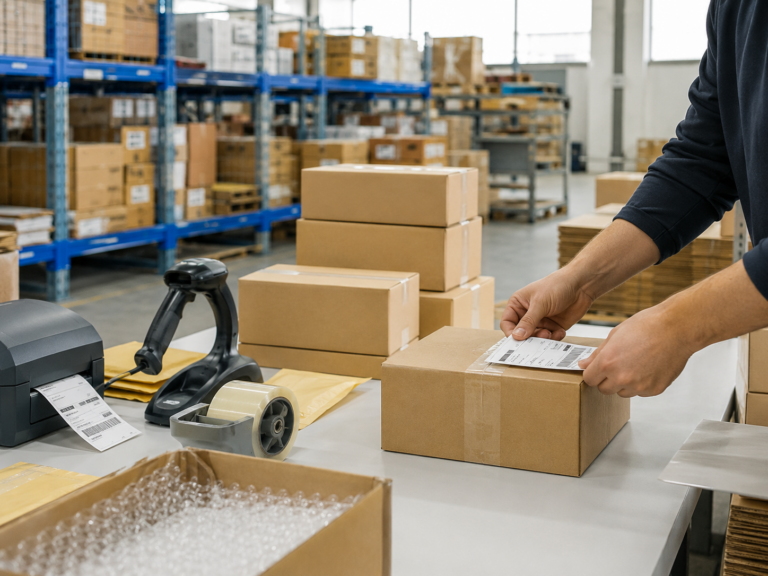
Choosing an FBA prep center is a bigger decision than many Amazon sellers expect. At first, it may seem like you only need someone to receive inventory, apply labels, and forward cartons to Amazon. But once your products are in someone else’s warehouse, accuracy, communication, turnaround time, and process matter a lot.
The right FBA prep center can help keep inventory moving, reduce avoidable Amazon compliance issues, and give you more control over imported or supplier-shipped products. The wrong one can create expensive delays, mislabeled inventory, rejected shipments, missing units, storage confusion, and unhappy customers.
Before you send your next shipment, use these questions to ask an FBA prep center so you can compare providers more confidently.
What FBA Prep Services Do You Actually Offer?
Not every FBA prep company provides the same level of support. Some centers are built for simple labeling and carton forwarding. Others offer a wider range of e-commerce prep, inspection, bundling, storage, returns handling, and fulfillment support.
Ask whether they handle:
- FNSKU labeling
- Poly bagging
- Bubble wrapping
- Bundling and kitting
- Product inspection
- Carton forwarding
- Case-packed shipments
- Individual-unit shipments
- Removal orders
- Returns processing
- Short-term storage
- Long-term storage
This question matters because your needs may change. A seller who only needs basic labeling today may need product inspection, bundling, or storage support later.
If you are comparing FBA prep companies, start with your current needs, but also think about what your business may require six months from now.
How Do You Receive and Check In Inventory?
Receiving is one of the most important parts of the FBA prep process. If inventory is not checked in accurately, problems can happen before prep even begins.
Ask how the provider handles inbound shipments from suppliers, freight forwarders, parcel carriers, domestic warehouses, or overseas shipments arriving by pallet or container.
Good questions include:
- How do you notify clients when inventory arrives?
- Do you count cartons, units, or both?
- How quickly is inventory checked in after delivery?
- Do you inspect cartons for visible damage?
- Do you photograph damaged freight?
- Can you receive palletized freight?
- Can you work with freight forwarders or trucking companies?
For Amazon sellers, receiving delays can affect launch dates, stock levels, advertising plans, and cash flow. A good prep center should have a clear receiving process and be able to explain it simply.
What Is Your Standard Turnaround Time?
Turnaround time is one of the most important questions to ask an FBA prep center. Some providers can move simple shipments quickly, while others may need more time depending on volume, service type, staffing, seasonality, or inspection requirements.
Ask for realistic turnaround times, not just best-case answers.
You should ask:
- What is your normal turnaround time for standard FBA prep?
- When does the turnaround clock start?
- Does it start when inventory arrives or after check-in?
- Are turnaround times different during Q4?
- Do large shipments require advance notice?
- Do you offer rush service?
- What causes delays?
A reliable provider should be honest about timing. Be careful with vague answers like “usually pretty fast” if they cannot explain what that means.
How Do You Handle Amazon Labeling Requirements?
Labeling mistakes can create serious issues. Incorrect FNSKU labels, uncovered manufacturer barcodes, mixed SKUs, or poorly placed labels can lead to delays, stranded inventory, or customer complaints.
Ask how they manage labeling accuracy.
Important questions include:
- How do you verify FNSKU labels before applying them?
- Do you cover or remove manufacturer barcodes when required?
- How do you prevent labels from being applied to the wrong SKU?
- Can you work from seller-provided shipment plans?
- Do you follow Amazon requirements for poly bags, suffocation warnings, sets, and fragile items?
- Is there a final quality-control check before outbound shipment?
A strong FBA prep center should have a repeatable process. You do not need them to make the process sound complicated. You do need them to show that they take accuracy seriously.
Do You Offer Product Inspection?
Not every FBA prep center includes inspection in basic prep. Some offer only a quick visual check. Others can inspect all units, check samples, compare items to reference photos, review packaging, or report obvious defects.
Ask what inspection means in practical terms.
For example:
- Do you inspect every unit or only a sample?
- Can you check for visible product damage?
- Can you compare products to reference photos?
- Can you identify packaging issues before inventory goes to Amazon?
- Do you provide photos or inspection notes?
- Can you separate damaged or questionable units?
This is especially important for private-label sellers, imported products, seasonal goods, fragile items, and higher-value products. If inventory is coming from overseas, your FBA prep center may be your last chance to catch visible problems before products enter Amazon’s network.
How Is Pricing Structured?
FBA prep pricing can look simple at first, but the total cost may include several different charges. A low per-unit prep rate does not always mean the provider will be the lowest-cost option overall.
Ask for a full pricing breakdown.
Common fees may include:
- Receiving fees
- Labeling fees
- Poly bagging fees
- Bundling fees
- Kitting fees
- Inspection fees
- Storage fees
- Pallet handling fees
- Carton forwarding fees
- Account setup fees
- Rush fees
- Removal order fees
- Returns processing fees
One of the best FBA prep center pricing questions is: “What charges might apply beyond the standard prep fee?”
The goal is not always to find the cheapest provider. The goal is to understand the total cost and avoid surprises.
Where Are You Located?
Location can matter a lot for Amazon sellers. An FBA prep center near a port, supplier warehouse, freight hub, or major parcel network may help reduce transit time and simplify freight movement.
For example, sellers importing through Southern California may look for FBA prep centers near Los Angeles, Long Beach, or the Inland Empire. Sellers moving inventory through Texas may compare FBA prep companies in Dallas, Houston, or other central distribution markets.
Ask:
- Are you near major ports, highways, rail hubs, or Amazon fulfillment regions?
- Can you receive LTL or full truckload shipments?
- Can you work with freight forwarders?
- Can you help coordinate outbound shipments?
- Do you serve sellers outside your local area?
Location is not the only factor, but it should support your supply chain.
How Do You Communicate With Clients?
Poor communication is one of the biggest complaints sellers have about logistics providers. Inventory is time-sensitive. You need to know when products arrive, when there is a problem, when prep starts, and when shipments leave.
Ask how communication works before you send inventory.
Good questions include:
- Do you use a client portal?
- Who is my main point of contact?
- How quickly do you respond to messages?
- Will I receive photos if there is a problem?
- How do you notify me when prep is complete?
- Do you provide shipment status updates?
- How do you handle urgent questions?
A provider’s communication during the sales process often tells you what to expect later.
What Types of Sellers Are a Good Fit?
Some FBA prep centers are better for new sellers. Others are designed for higher-volume Amazon businesses, importers, wholesale sellers, private-label brands, or e-commerce companies with multiple sales channels.
Ask whether your business is a good fit.
Questions to ask:
- Do you work with new Amazon sellers?
- Do you support high-volume sellers?
- Do you handle oversized products?
- Do you work with private-label brands?
- Do you support imported products?
- Are there product types you do not accept?
This helps you avoid choosing a provider that can technically do the work but is not the right operational fit.
Common Mistakes When Choosing an FBA Prep Center
The most common mistake is choosing based only on price. Low pricing is attractive, but labeling errors, poor communication, slow turnaround, or inventory confusion can cost far more than the savings.
Another mistake is assuming every provider offers the same services. Some FBA prep centers are simple forwarding warehouses. Others offer broader e-commerce fulfillment and inspection support.
A third mistake is waiting until inventory is already on the way. It is much better to choose your FBA prep provider before your supplier ships.
FAQ
What are the most important questions to ask an FBA prep center?
Ask about services, receiving, turnaround time, labeling accuracy, inspection options, pricing, storage, communication, and experience with your type of product.
How do I choose an FBA prep center?
To choose an FBA prep center, compare services, location, turnaround time, pricing, communication, Amazon prep experience, and the provider’s ability to handle your current and future volume.
What does an FBA prep center do?
An FBA prep center prepares inventory for shipment to Amazon fulfillment centers. Services may include labeling, poly bagging, bundling, inspection, storage, carton forwarding, and removal order handling.
Is an FBA prep center the same as a 3PL?
Not always. An FBA prep center focuses on preparing inventory for Amazon. A 3PL may offer broader warehousing, fulfillment, storage, and shipping services for multiple sales channels.
Should I use an FBA prep center for imported products?
Many importers use FBA prep centers to receive, inspect, label, and forward products before they go to Amazon. This can be especially useful if overseas suppliers do not handle Amazon prep requirements correctly.
Find FBA Prep Providers on National Freight Hub
The right FBA prep center should help you move inventory efficiently, reduce avoidable mistakes, and keep your Amazon business running smoothly.
Use National Freight Hub to compare FBA prep companies, review service capabilities, and find providers that match your location, volume, and prep requirements.
