
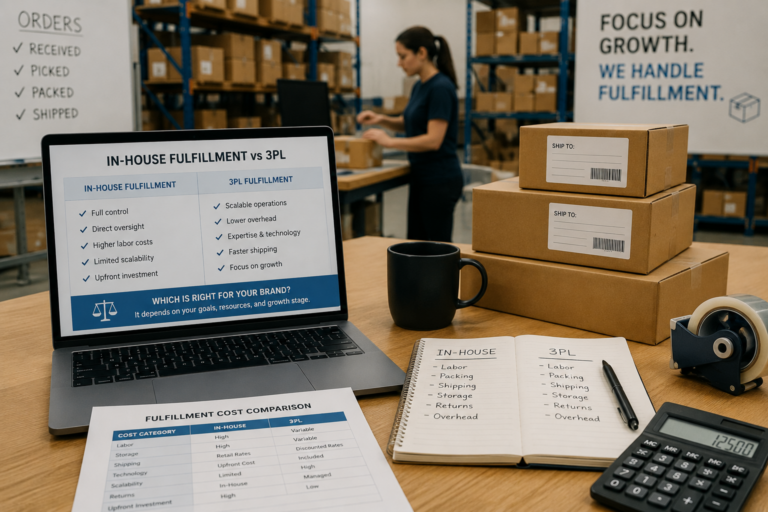
In-house fulfillment vs 3PL is usually a question of control, complexity, and growth stage, not just cost. Many e-commerce brands begin with in-house fulfillment because it is simple, visible, and inexpensive at the start. The founder sees every order. The team knows the products. Problems are caught quickly because the inventory is right there.
At low volume, that can be a strength.
Eventually, the same setup can become a bottleneck. Packing tables take over office space. Inventory gets harder to find. Orders ship late when the team gets busy. Returns pile up. Customer service spends more time answering tracking questions. The business is still growing, but fulfillment starts absorbing energy that should be going into sales, product development, or customer retention.
That is usually when brands start comparing in-house fulfillment vs 3PL.
When In-House Fulfillment Makes Sense
In-house fulfillment gives a brand control. That control matters in the early stage.
If packaging presentation is still being refined, if products are fragile, if inserts change weekly, or if the founder wants to personally see what customers receive, keeping fulfillment internal can be useful. It also helps the team understand the physical reality of the business. You learn which SKUs are awkward to pack, which products break, which boxes waste space, and which returns keep happening.
Those lessons are valuable. Outsourcing too early can hide problems before the brand understands them.
In-house fulfillment also avoids some third-party fees. There may be no pick fee, no storage minimum, and no account management charge. But that does not mean it is free. Labor, space, packaging, shipping software, mistakes, weekend packing, and delayed orders all have a cost.
When a 3PL Becomes the Better Fit
A 3PL becomes attractive when fulfillment needs structure, space, labor, and repeatability.
The biggest benefit is operational capacity. A 3PL is built to receive inventory, store products, pick orders, ship packages, process returns, and keep records. A good provider can turn fulfillment from a daily scramble into a managed workflow.
That matters more as order volume grows. U.S. e-commerce sales accounted for 16.9% of total retail sales in Q1 2026, according to the Census Bureau. Online retail is a large, established channel, and customer expectations are shaped by fast shipping, clear tracking, and easy returns.
A 3PL can also help brands expand beyond one sales channel. If orders come from Shopify, Amazon, Walmart, TikTok Shop, wholesale customers, and retail accounts, a warehouse partner may help centralize inventory and keep orders moving.
The Real Decision Is About Complexity
The question is not simply, “How many orders do we ship?”
Order count matters, but complexity matters just as much.
A brand shipping 500 identical lightweight units each month may be able to fulfill in-house longer than a brand shipping 200 orders across 80 SKUs with fragile packaging, returns, bundles, and wholesale cartons. A small product catalog is easier to manage. A high-SKU catalog with variations is more error-prone. Apparel returns are different from supplement replenishment. Oversized home goods are different from jewelry.
Outsourcing starts to make more sense when complexity begins to slow the business down.
In-House Fulfillment vs 3PL: A Practical Comparison
| Factor | In-House Fulfillment | 3PL Fulfillment |
| Control | Highest | Shared with provider |
| Startup cost | Often lower | May include onboarding and minimums |
| Scalability | Limited by space and labor | Better for growing volume |
| Packaging flexibility | Very flexible | Depends on provider |
| Inventory visibility | Direct physical control | Depends on systems and reporting |
| Returns handling | Manual but visible | More structured if provider is strong |
| Best fit | Early-stage or highly custom operations | Growing brands needing repeatable fulfillment |
This is not a permanent choice. Many brands fulfill in-house early, move to a 3PL as volume grows, and later split inventory across multiple nodes or channels.
Signs You May Be Ready for a 3PL
The clearest sign is not a specific order number. It is when fulfillment starts interfering with the rest of the business.
If orders are shipping late because the team is busy, that is a signal. If inventory counts are no longer trusted, that is a signal. If returns are sitting unopened, that is a signal. If the brand is leasing extra space just to hold cartons, that is a signal. If the founder is still packing orders at midnight, that is definitely a signal.
Outsourcing does not solve every problem. A messy catalog, unclear SKU naming, bad packaging, or unreliable suppliers will still create issues at a 3PL. But a strong provider can give the business a more stable operating base.
Do Not Outsource Chaos
This is the part brands often miss: a 3PL will not magically fix a disorganized operation. It may simply make the disorganization more visible and more expensive.
Before moving to a 3PL, clean up SKU names, barcodes, product dimensions, packaging rules, bundle definitions, and return instructions. Decide which products can be restocked and which need review. Confirm how inventory will be counted at receiving. Make sure sales channels are connected correctly.
The cleaner the handoff, the better the 3PL relationship will start.
Returns Should Influence the Decision
Returns are a major reason to think carefully about fulfillment structure. NRF and Happy Returns projected that 19.3% of online sales would be returned in 2025. If your category has meaningful return volume, the provider’s return process matters almost as much as outbound shipping.
For some brands, in-house returns are useful because the team learns exactly why customers send products back. For others, returns quickly become a space and labor problem. A 3PL can help, but only if it has clear instructions for inspecting, restocking, discarding, or holding returned items.
The Best Answer May Be Hybrid
Some brands do not need to choose one model completely.
A hybrid model may keep VIP orders, influencer kits, samples, or custom bundles in-house while a 3PL handles standard daily fulfillment. Another brand may keep slow-moving or fragile products internally and outsource high-volume SKUs. Some Amazon sellers keep FBA inventory separate while a 3PL handles Shopify and wholesale orders.
The right fulfillment model should support the business, not force the business into a rigid warehouse process.
FAQ
Is in-house fulfillment better than using a 3PL?
In-house fulfillment offers more direct control and can work well at lower volume. A 3PL is usually better when order volume, SKU complexity, returns, or space constraints make fulfillment harder to manage internally.
When should an e-commerce brand outsource fulfillment?
A brand should consider outsourcing when fulfillment is delaying orders, consuming too much team time, creating inventory issues, or preventing the business from scaling.
Is a 3PL cheaper than in-house fulfillment?
Not always. A 3PL adds fees, but it may reduce labor, space, shipping inefficiency, errors, and management burden. The right comparison should include total operational cost, not just warehouse fees.
Can a brand use both in-house fulfillment and a 3PL?
Yes. Many brands use a hybrid model, keeping custom or strategic orders in-house while outsourcing standard order fulfillment to a 3PL.
