
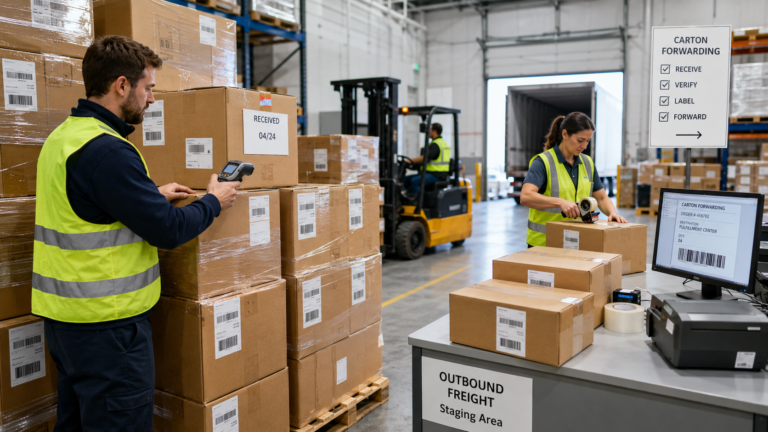
Carton forwarding is the process of receiving cartons, verifying or preparing them, applying required outbound labels, and sending them to the next destination. For Amazon sellers, that destination is often an Amazon fulfillment center.
At its most basic, carton forwarding means a provider receives cartons, verifies or prepares them, applies the required outbound labels, and sends them to the next destination. For Amazon sellers, that destination is often an Amazon fulfillment center.
The work may look minor from the outside. A few cartons arrive. Labels go on. Boxes ship out. But for Amazon FBA, carton-level accuracy matters. The wrong box label, an unscannable barcode, mixed SKUs, or a mismatch between box contents and the shipment workflow can create receiving delays that sellers only discover after inventory is already in Amazon’s network.
What Carton Forwarding Does for Amazon Sellers
Carton forwarding sits between receiving and final delivery to Amazon.
A typical process looks like this:
- Inventory arrives at a prep center, warehouse, or forwarding facility.
- Cartons are checked in.
- The provider confirms carton count and visible condition.
- Any required prep is completed.
- Unit labels are verified or applied if needed.
- Cartons are matched to the seller’s shipment plan.
- FBA box ID labels are applied.
- Cartons are handed off to the carrier.
Amazon’s shipping label requirements state that each box in an FBA shipment must have its own FBA box ID label printed from the shipment workflow. Each pallet also requires four pallet labels, one on each side.
That is why carton forwarding is not just “send these boxes.” It is a label-controlled handoff.
Carton Forwarding vs FBA Prep
Carton forwarding and FBA prep overlap, but they are not identical.
FBA prep may include unit-level work such as FNSKU labeling, poly bagging, bubble wrapping, bundling, set creation, and inspection.
Carton forwarding is more focused on the outbound movement of cartons to Amazon.
The two often happen together. For example, a prep center may receive imported goods, apply FNSKU labels, repack products into shipping cartons, apply FBA box labels, and forward those cartons to Amazon.
But a provider that only does basic carton forwarding may not inspect units, create bundles, or fix packaging problems. Sellers should not assume those services are included.
When Carton Forwarding Makes Sense
Carton forwarding is useful when inventory needs a controlled stop before Amazon.
That may happen when:
- Products arrive from an overseas supplier
- A freight forwarder delivers cartons after import clearance
- Inventory needs to be split across multiple Amazon shipments
- Units need labels before cartons are sealed
- Cartons need Amazon box labels
- A seller does not have its own warehouse
- Inventory needs short-term holding before shipment creation
- A supplier cannot follow Amazon shipment requirements reliably
For many sellers, carton forwarding is the cleanest way to avoid sending import cartons directly from a port-side warehouse or supplier into Amazon without a final check.
Why Imported Products Often Need This Step
Imported products are a common carton forwarding use case.
A supplier may pack cartons correctly for export but not for Amazon. The cartons may have factory labels, old shipping marks, mixed variations, master cartons, or missing Amazon-specific labels. Sometimes the product itself is fine, but the carton-level presentation is not ready for FBA receiving.
A forwarding provider can catch practical problems before the shipment leaves:
- Cartons do not match the shipment plan.
- The wrong number of units is packed per carton.
- SKUs are mixed without clear documentation.
- FNSKU labels are missing at the unit level.
- Conflicting barcodes are still visible.
- Cartons are damaged from international freight.
- FBA box ID labels have not been applied.
None of those issues are glamorous. All of them can slow inventory down.
Unit Labels Still Matter
Carton forwarding does not replace unit-level labeling.
Amazon’s product packaging requirements say each unit must have an exterior scannable barcode or label.
That matters because a perfectly labeled shipping carton can still contain units that are not ready for FBA. If the units inside require FNSKU labels, those labels need to be applied before cartons are sealed and forwarded.
Amazon’s 2026 barcode changes make this even more important. As of March 31, 2026, Amazon says brand owners can continue using manufacturer barcodes without stickers in certain cases, while resellers are required to use Amazon barcodes even if manufacturer barcodes are already present.
Before choosing a carton forwarding provider, sellers should confirm whether the provider can check unit barcodes, not just carton labels.
Box Labels Are Not Interchangeable
Every FBA carton needs the correct box label. That label is tied to the shipment workflow and box contents.
Problems happen when:
- The same label is applied to multiple cartons.
- Labels are applied to the wrong boxes.
- Old carrier labels remain visible.
- Barcodes fold over corners.
- Labels are covered with tape.
- Cartons are reworked but box contents are not updated.
- Shipment plans change after labels are printed.
Amazon requires box labels to remain scannable and readable. That sounds basic, but it is one of the easiest things to get wrong when a warehouse is rushing.
Carton Forwarding vs Cross-Docking
Carton forwarding and cross-docking can look similar, but they are not the same service.
Cross-docking usually means freight moves through a facility quickly with little or no storage. It is a speed and transfer function.
Carton forwarding for Amazon is more specific. It may include shipment matching, Amazon box labeling, unit-label verification, damage checks, short-term holding, and coordination with FBA shipment requirements.
A standard cross-dock provider may be great at moving freight but unfamiliar with Amazon’s labeling workflow. For FBA sellers, that difference matters.
What to Confirm Before Sending Cartons
A seller should confirm these details before inventory arrives:
- Who creates the Amazon shipment?
- Who prints the FBA box ID labels?
- Who applies carrier labels?
- Who verifies unit barcodes?
- Are old barcodes or labels covered?
- Can the provider receive LTL or palletized freight?
- Can they separate SKUs?
- Can they hold inventory if shipment plans change?
- What happens if cartons arrive damaged?
- How quickly are cartons forwarded after prep?
- How are exceptions reported?
The provider should be able to walk through the handoff clearly. If the answer is vague, the process probably is too.
FAQ
What is carton forwarding for Amazon sellers?
Carton forwarding is the process of receiving cartons, verifying or preparing them, applying required outbound labels, and sending them to Amazon fulfillment centers.
Is carton forwarding the same as FBA prep?
Not exactly. FBA prep can include unit-level labeling, poly bagging, bundling, inspection, and packaging. Carton forwarding focuses on moving prepared cartons to Amazon.
Do cartons sent to Amazon need FBA box labels?
Yes. Amazon says each box in an FBA shipment must have its own FBA box ID label printed from the shipment workflow.
Can carton forwarding providers handle imported products?
Many can, but sellers should confirm the provider can receive freight, inspect carton condition, verify labels, separate SKUs, and forward cartons according to Amazon shipment requirements.
